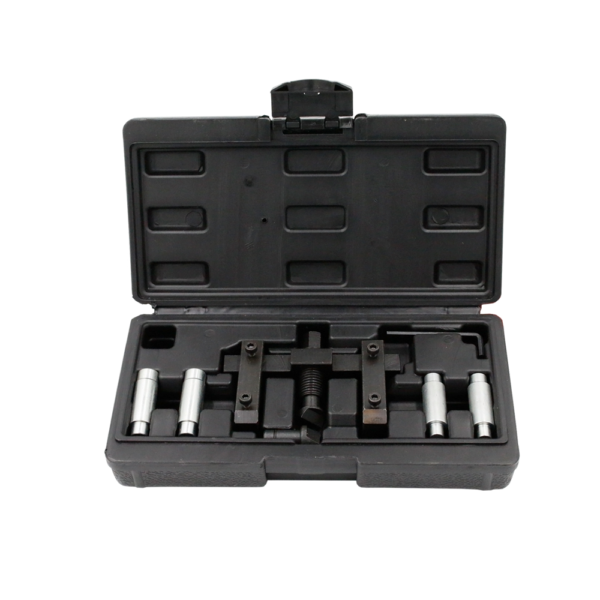
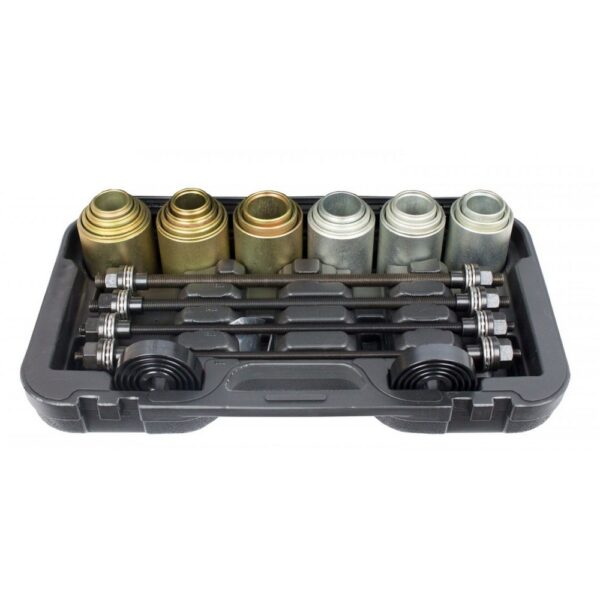
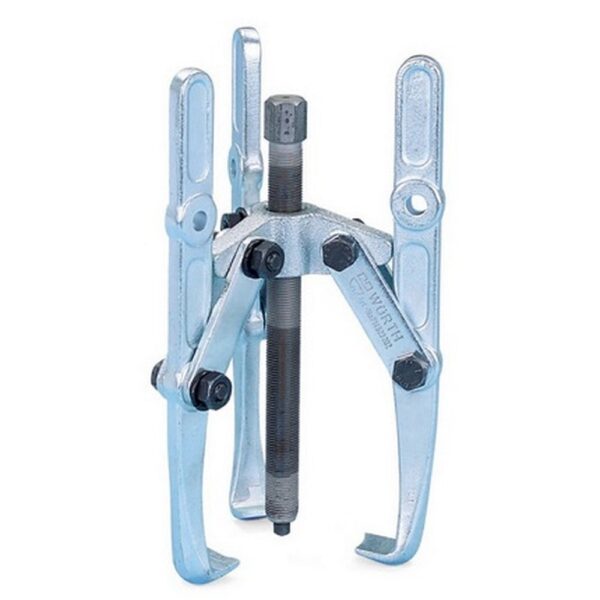
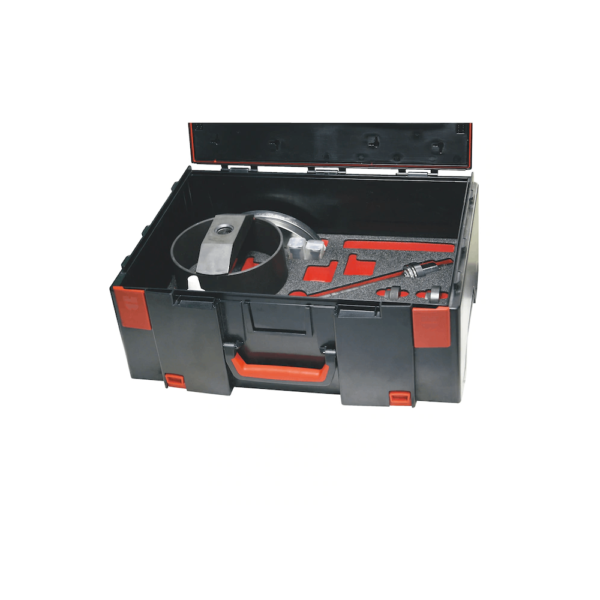
Pullers are used to remove bearings, pulleys, gears and ball bearings without using a hammer. They grip the part by its ends and apply steady pressure from the centre, so the housing does not crack and the bearing itself is not damaged. At Geosantro you’ll find a 250-millimetre tripod puller, a 26-piece bearing removal and installation set, a seven-piece ball cage separator set and bearing removal tools. Before ordering, measure the diameter and depth of the part you wish to remove. Please ask us if you need a larger opening or a hydraulic puller. Free delivery throughout Cyprus on orders over 50 euros.
Showing all 4 results

In stock

In stock

In stock

Only 1 left in stock
The puller pulls a part out of its position without striking it. It grips the ends with its claws and applies steady pressure from the centre using a screw. This is how you remove bearings, pulleys, gears and half-shafts that have become stuck in place over the years.
The tripod distributes the force across three points, so it pulls more straight and is less likely to slip or warp the piece. The two-legged saw is easier to use where space is tight or where the piece has flat sides. If you’re only going to buy one, the three-legged saw is more versatile.
It shows the width and depth covered by the claws, i.e. how large a section you can grip. Before you buy, measure the diameter of the bearing or pulley you want to remove and how deep it sits. A puller that doesn’t fit properly will slip the moment you apply pressure.
It is a complete set comprising discs, spacers and pullers that allow you to remove and install bearings and rings from their housings. It works by applying pressure rather than impact, so you won’t damage either the bearing or the housing. The 26-piece set covers a wide range of diameters.
The separator opens up the cone of the end rod or ball joint so that it comes out of its socket, without having to tap the joint or the bushing with a hammer. The seven-piece set covers a range of sizes, so it works on many different car models within a garage.
The hammer transfers the impact throughout the entire component. A bearing that has been hammered will make a whirring noise and fail within a few months, even if it looks fine. It may also crack the cast housing or bend the shaft. The puller pulls gently and in a controlled manner, without any impact load.
First clean the area and apply a little rust remover if the part is rusty. Centre the screw exactly on the shaft, make sure the prongs are aligned straight, and tighten gradually with a spanner. If anything starts to go awry, stop and start again from the beginning rather than forcing it any further.
The mechanical screw puller is suitable for most jobs on cars and small engines. The hydraulic puller is useful when you’re regularly removing large bearings from heavy vehicles or industrial equipment, as it provides much greater force with less effort. Tell us what kind of work you do and we’ll recommend the right tool for you.
It refers to how much the reading may deviate for every metre of length. An accuracy of half a millimetre per metre means that over two metres, the deviation amounts to one millimetre. For building and installation work, this is perfectly fine, but for precision work, look for a tool with a smaller deviation.
Clean off any oil and dust after use and lightly oil the thread of the central screw, as that is where all the pressure is applied. Check the claws for cracks or warping and do not force them beyond their opening. Store it in its case so that no parts get lost.
From Geosantro. You’ll find a 250-millimetre tripod extractor, a 26-piece ball bearing removal and installation set, a seven-piece ball retainer separator set and bearing removal tools, with free delivery throughout Cyprus on orders over 50 euros. Tell us what you want to remove and we’ll guide you through it.