
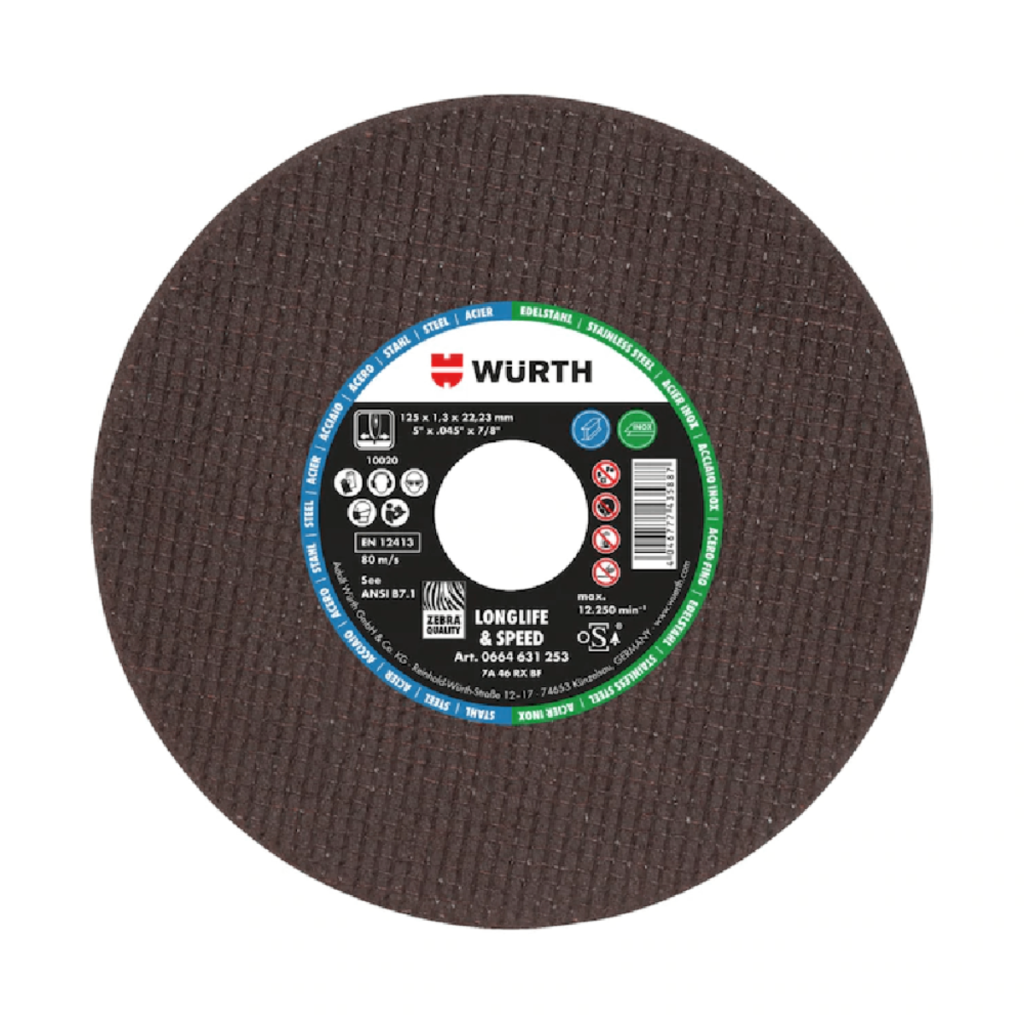
Cutting Discs: How to Read the Labelling and Which One to Choose
The label on the cutting disc is not just for decoration. Within a few centimetres of paper, there are

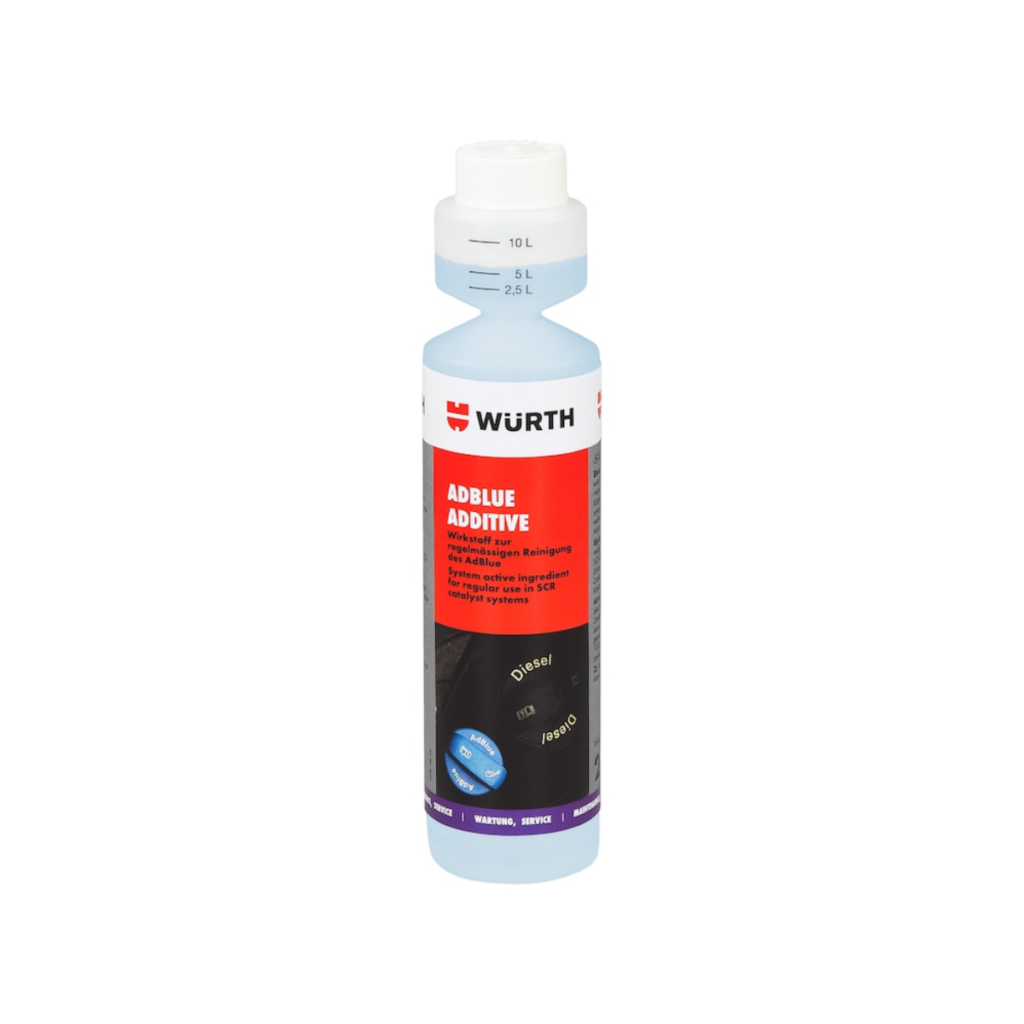
AdBlue is not a fuel additive and is never put into the fuel tank. It is a urea solution that is injected into the exhaust system of modern diesel engines to reduce nitrogen oxides. The tank needs topping up every few thousand kilometres, and the liquid is more sensitive than it appears. A little tap water, a dusty funnel or a summer’s day in a locked car are enough to cause problems with the SCR catalytic converter. Below, you’ll find out how it works, when to top it up and what to avoid.
AdBlue is a solution of 32.5% high-purity urea in deionised water. This composition is not arbitrary: it is defined by the ISO 22241 standard, which also sets the maximum limits for metals and other impurities. At this concentration, the solution has the lowest possible freezing point whilst providing the catalytic converter with exactly the right amount of ammonia.
In practice, a pump draws the liquid from a separate tank and a nozzle sprays it into the exhaust gases before they pass through the selective catalytic reduction (SCR) catalyst. The heat breaks down the urea into ammonia; the ammonia reacts with the nitrogen oxides; and nitrogen and water vapour are emitted from the exhaust. Without this process, a Euro 6 vehicle cannot meet the emission limits for which it was designed.
Fuel consumption is usually around 3% to 5% of diesel consumption, but it increases during continuous driving with a load, on uphill gradients and on the motorway. A passenger car may need topping up every 5,000 to 10,000 kilometres. A lorry or construction vehicle requires it much more frequently.
Your dashboard warns you well in advance. The first warning usually appears when you still have a few thousand kilometres of range left, so that you can take action in time. If you ignore it, the warning becomes more prominent, power is restricted and eventually the vehicle will not start again until AdBlue is added. This is not a fault but a programmed function, and applies to almost all makes.
Don’t leave it until the last minute. The simplest thing to do is to keep a container in the boot or in the garage storeroom and top up as soon as the first warning light comes on.
The SCR catalytic converter is an expensive component and does not tolerate contaminants. The main factors that cause it to fail are as follows:
Most of these issues are not immediately apparent. The problem becomes apparent later in the form of a fault light, increased AdBlue consumption or a failure at the MOT test.
A few white crystals around the filler neck are to be expected, especially if a small amount of fluid has been spilled. They can be wiped away with a damp cloth and water. What is not normal, however, is crystals forming around the spray nozzle or in the exhaust, as this indicates that the liquid is not evaporating properly within the system.
AdBlue freezes at -11°C. In Cyprus, this is rarely a concern, but it’s worth knowing that freezing does not spoil the fluid: once it has thawed, it works as normal. The risk lies with the tank, as the fluid expands when it freezes and may cause it to burst. Vehicles are already fitted with a tank heating system for precisely this reason.
This is where the practical problem lies for Cyprus: it is the heat, not the cold. AdBlue has a shelf life of around 18 months when stored correctly, i.e. in a cool, shaded place. Above 30°C, its shelf life drops significantly, by around six months for every additional 5°C. A container left in the boot or in the sun outside the storeroom in July has already lost a large part of its shelf life.
Keep the containers closed, away from direct sunlight, and check the production date before using a container that has been standing for some time. If the liquid has become cloudy or has changed colour, do not use it.
Switch off the engine and locate the cap, which is almost always blue and is situated next to the fuel cap or in the boot. Clean around the opening before unscrewing it. Fill it up slowly, without filling it to the brim, as the fluid needs room to expand. Wipe up any spill immediately, both to protect the paintwork and to prevent crystals from forming. Once filled, some vehicles require you to turn the switch to the ‘on’ position for one or two minutes so that the sensor can read the new level.
Two containers that look identical on the shelf may not actually be the same. Before you buy, check three things. Firstly, look for the reference to the ISO 22241 standard on the label, as this is the only guarantee of the solution’s purity. Secondly, the production date, so that you know how long the liquid will last and the conditions under which it has been stored over the last few months. Thirdly, the seal on the container, which must be intact.
Avoid buying in bulk from unknown sources and containers that have been left exposed to the sun. The difference in price is minimal, whilst the damage to an SCR catalytic converter costs many times that amount. For garages and vehicle fleets, placing an order with the correct stock rotation solves the problem once and for all.
At Geosantro, you’ll find AdBlue in 10-litre containers, as well as the Alpine version for lower temperatures. Please ask us if you need larger quantities for a fleet or a workshop.
No, and it’s one of the most expensive mistakes you can make. AdBlue has its own tank with a blue cap and is never mixed with the fuel. If it is accidentally poured into the fuel tank, do not start the engine under any circumstances. The fuel system must be drained and cleaned by a garage before the vehicle is driven again.
This AdBlue is formulated to perform better at low temperatures during storage and transport. The chemical composition remains compliant with the ISO 22241 standard, so the vehicle will not notice any difference in performance. In Cyprus, this is particularly relevant for mountainous areas in winter or for stock kept in unheated premises.
Less than a sealed one, because air and dust get in every time you open it. Close it tightly immediately after use and store it in a cool, shaded place. If the container has been left open or half-empty for months in a warm place, it’s better to buy a new one rather than risk damaging the catalyst for the sake of a few euros.
This is usually because the level sensor has not yet had time to update. Leave the switch in the ‘on’ position for a minute or two and drive a short distance to allow the measurement to complete. If the warning light remains on, check whether you may have added too little fluid, or contact a garage to have the SCR system diagnosed.
The label on the cutting disc is not just for decoration. Within a few centimetres of paper, there are
The three materials look the same inside the cartridge but behave completely differently on the joint.