What Tools Does a Carpenter Need: The Guide to the Woodworking Workshop

Share This Post
tools for professionals

Carpentry is an art that combines traditional craftsmanship with the power of modern technology. A carpenter transforms raw lumber into functional furniture, structural elements, and works of art, and to achieve this, they rely on an extensive arsenal of tools. From the delicate carving with a chisel to the precise cutting with a table saw, every tool serves a specific purpose in the creation process.

This article analyzes the essential tools that make up the professional carpenter's workshop, divided into three main categories: hand tools, power tools, and auxiliary accessories.

Hand Tools: The Foundation of Carpentry

Hand tools are the soul of woodworking. They offer a direct feel for the material, absolute control, and are essential for tasks requiring precision and detail, regardless of electrical power availability.

Cutting and Striking

  • Hand Saws: Although power saws dominate, the handsaw remains essential for fine, small, or quick cuts where setting up a machine is unnecessary. Different types exist, such as miter saws and dovetail saws for fine work. Find more.
  • Hammers: The classic claw hammer is the most common tool. It's used for driving nails and, thanks to its claw, for their removal. Choosing the right weight and balance is crucial to prevent fatigue. Find more.
  • Chisels: These are arguably the most important hand tools for precise material removal. They are used to create joints (such as mortise and tenon or lap joints) or to create recesses for hinges and locks. They require frequent sharpening to remain absolutely keen.

Measuring and Marking

Accuracy is key in carpentry. A mistake of a millimeter can ruin a joint or an entire project.

  • Tape Measure: The tape measure is the most basic measuring tool. A good carpenter needs tape measures with accurate and easy-to-read markings. Find more.
  • Squares: Used for scribing lines and checking the squareness (90 degrees) of corners.
  • Bevel Gauges and Levels: The bevel gauge measures and transfers angles, while the level is used to check if a surface is perfectly horizontal or vertical (plumb). Find more.
  • Pencils, Scribing Tools, and Markers: Used to mark cutting lines, joint locations, and hole positions. Professionals often use special carpenter's pencils or scribing knives for greater accuracy.

Creating Holes and On-Site Work

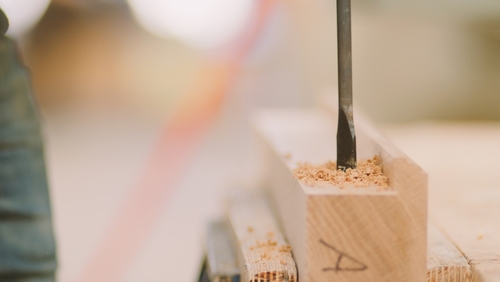
  • Hand Drill: Although power drills are faster, the hand drill gives the craftsman full control over speed and force, which is important when drilling small, delicate holes or driving screws without the risk of splitting the wood.

Power Tools and Machinery: Power and Speed

Power tools revolutionized carpentry, allowing craftsmen to perform heavy cutting, drilling, and sanding tasks with speed, precision, and repeatability that were impossible with hand tools.

Drilling and Driving

  • Electric Drills and Drivers: Essential for creating holes at high speed and for driving/removing screws. There are two main types:
    • Drills: For creating holes.
    • Electric Screwdrivers/Impact Drivers: For fast and efficient screw placement. Find more.

Cutting and Shaping

  • Saws:
    • Table Saw: The center of almost every workshop. Used for fast and accurate cutting of large pieces of wood to specific dimensions, especially for parallel cuts.
    • Miter Saw: Ideal for cutting wood at various angles (cross-cutting), essential for frames, baseboards, and casings.
    • Jigsaw: Used for cutting curves and complex shapes in thinner wood. Find more.
    • Circular Saw: A portable tool for quick, straight cuts, especially useful for on-site work.
  • Chainsaws: Although not a tool for detailed carpentry, they are essential for heavy and fast cutting of thick logs, mainly in the initial processing of raw wood or in framework construction work.
  • Routers: Powerful tools used for cutting grooves, dadoes, rabbets, shaping edges, or creating decorative profiles (such as curves or molding). They are indispensable for constructing complex joints and for the aesthetic completion of a project.

Sanding and Finishing

  • Sanders: Any woodworking project requires sanding to prepare it for the final finish (varnish, paint). There are various types:
    • Random Orbital Sanders: The most versatile, for general sanding.
    • Detail Sanders: For sanding in corners and tight spots.
    • Belt Sanders: For rapid removal of a large amount of material.

Auxiliary Tools and Materials: Organization and Stability

These tools don't cut or drill, but they are equally crucial, as they ensure the stability, safety, and quality of the project.

Stabilization and Clamping

  • Clamps: Perhaps the most underrated, yet essential, tool. Clamps hold pieces of wood firmly in place during gluing, cutting, or drilling, ensuring that the joint or cut is accurate. Many types exist (F-clamps, C-clamps, strap clamps) for different needs. Find more.
  • Jigs: While often referred to as guides or aids, jigs are specialized fixtures used to hold materials at a specific position or angle, allowing for repetitive and highly accurate cuts or holes (e.g., pocket hole jigs).
  • Locking/Binding Mechanisms: This likely refers to specific clamping mechanisms used to secure large or heavy materials to the workbench, or quick-release clamps that "lock" with a lever.

Final Processing and Cleanup

  • Scrapers and Hand Planes:
    • Hand Planes: Used for smoothing, correcting, and removing thin layers of wood from surfaces. They are required for the final adjustment of doors or smoothing large surfaces before sanding.
    • Scrapers: Thin pieces of metal with a sharp edge used to remove old finishes, glue, or for the final smoothing of a surface, offering a cleaner result than the sander.
  • Dust Collection Systems: The health of the carpenter and the cleanliness of the workshop are vital. Dust collection systems connect to power tools (saws, sanders, routers) to collect fine dust, which is hazardous to the lungs and affects the quality of the finish.
  • Personal Protective Equipment (PPE): Masks, safety glasses, ear protection, and gloves. These are not tools in the traditional sense, but they are the most important "accessories" of the workshop for the craftsman's safety. Find more.

Conclusion

In conclusion, the carpenter's workshop is an ecosystem where the power of machinery meets the precision of hand tools. Every tool, from the tape measure to the table saw, plays its role in transforming raw material into a perfectly constructed product. The success of a carpentry project depends not only on possessing these tools but primarily on the craftsman's ability to use them with skill, knowledge, and respect for safety.

Latest Blog