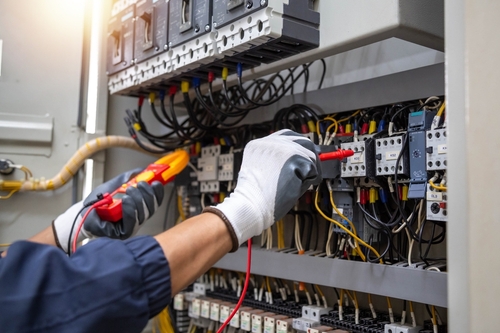

The electrical trade is a profession that demands precision, meticulousness, and, above all, absolute safety. The electrician is responsible for the installation, maintenance, and repair of the electrical systems that power our homes, businesses, and industries. To ensure the uninterrupted and safe flow of current, they rely on a specialized set of tools, many of which are specifically designed for working in environments with live voltage.
This article analyzes the essential tools that form the necessary arsenal of every professional electrician, divided into categories concerning safety, measurement, cutting, and connection.
Basic Tools: Safety, Measurement, and Preparation
The tools in this category are the first ones used in every job and are absolutely critical for protecting the technician and accurately preparing materials.
Voltage Testers and Measuring Instruments: Safety First
Before any intervention on an electrical installation, verifying the absence of voltage is the first and most crucial step.
- Voltage Testers / Multimeters: These are the most important diagnostic tools. The voltage tester (simpler or digital) is used to safely confirm whether a wire, socket, or switch is carrying electrical voltage.
- Multimeter: A more complex tool that measures voltage (Volts), current (Amps), and resistance (Ohms), as well as the continuity of the circuit. It is essential for fault diagnosis and verifying the proper functioning of a system.
- Clamp Meter: A specialized instrument that allows the electrician to measure the current (Amps) passing through a wire without interrupting the circuit or stripping the insulation, dramatically increasing the safety and speed of diagnosis. Find more.
Wire Stripping and Cutting
The proper preparation of wires is vital for a reliable and secure electrical connection.
- Wire Strippers: These tools are specifically designed to remove the outer insulation of cables without damaging the internal conductors. They come in various types (automatic or manual), with notches corresponding to different gauges (AWG or mm²). Find more.
- Cable Cutters: Specifically designed for precise cutting of cables, especially thick or heavily shielded cables. They provide a clean and perpendicular cut, which is essential for proper connections. Find more.
Pliers and Screwdrivers: Connection and Manipulation
- Pliers: Pliers are versatile tools used for cutting, twisting, and gripping wires and small components. The electrician typically carries various types, such as:
- Needle-Nose Pliers: For manipulating and bending wires in tight spaces.
- Diagonal Cutters: Essential for precisely cutting wires. Lineman’s Pliers: For gripping, pulling, and twisting thicker wires.
- Lineman’s Pliers: For gripping, pulling, and twisting thicker wires. Find more.
- Screwdrivers: Electricians must use insulated screwdrivers (certified with VDE or similarly), which feature insulation to protect the user from accidental contact with live current, even if the circuit is supposedly dead. They come in various types (flat-head, Phillips, Torx) to match the different screws used in switches, relays, and panels.
Connection and Installation Tools
This category includes the tools required for the final connection of wires and the installation of conduits.
Connection and Restoration
- Crimpers (Terminal Crimpers): These tools are used for connecting terminals (small metal connectors) to the ends of wires. Using a crimper ensures a strong, reliable, and safe electrical connection, essential for panels and industrial applications.
- Torches (or Soldering Irons): For applying heat-shrink materials or for soldering (tin soldering) in certain low-voltage applications, such as electronic circuits or sensitive connections.
Conduit Installation and Pulling Tools
- Fish Tape / Cable Puller (Electrician's Snake): An indispensable tool for pulling cables through conduits (electrical pipes), especially over long distances or through routes with many bends. They come in various lengths and materials (e.g., nylon, metal).
- Drills (Hammer and Rotary): For drilling holes in walls (concrete, brick) for mounting junction boxes, conduits, and securing equipment. Special drill bits are required for masonry drilling (e.g., diamond core bits for boxes). Find more.
Auxiliary Tools and Consumables: Organization and Finishing
These tools and materials contribute to project organization, marking, measuring, and completing the installation.
Measuring, Marking, and Securing
- Tape Measures: Essential for the accurate placement of sockets, switches, light fixtures, and wiring, ensuring the installation is symmetrical and compliant with designs. Find more.
- Markers and Pencils: Used for marking on walls, on wires (for identification of phase, neutral, ground), and on panels. The permanent marking of wires is crucial for future maintenance.
- Level: To ensure that sockets, switches, and electrical panels are installed perfectly straight. Find more.
- Tool Kits and Bags: For the safe transportation and organization of tools. Professional bags and toolboxes often include compartments for keeping sensitive measuring instruments and insulated tools in excellent condition. Find more.
Insulation and Protection
- Electrical Tape: A basic consumable for the safe marking of wires (e.g., black for phase, blue for neutral) and for protecting connections from wear, moisture, and dust. The tape must be durable and high-quality. Find more.
- Cable Ties: Used for organizing and bundling cables into groups within panels and conduits, contributing to ease of maintenance and a clean installation appearance.
- Heat Shrink Tubing: Special tubes that contract with heat, providing superior insulation and sealing for connections, especially outdoors or in moist environments.
Conclusion: The Value of Specialization
The electrician's arsenal is characterized by specialization and an uncompromising focus on safety. Every tool, from the simple voltage tester to the sophisticated multimeter, is used to ensure that electrical energy is routed accurately and without danger. The knowledge of how to use these tools, combined with adherence to safety regulations, is what makes a professional electrician essential to every modern building.